
Fayette Projected and Actual Release
WVDCR policy uses the terms projected minimum discharge date and minimum discharge/final release date. The scheduled date assumes continuous incarceration and no loss of good time. It describes the calculation as it stands, not what has already happened. The actual release is the custody event recorded when the facility processes a parole, discharge, conditional release, transfer, or other authorized exit.
A pretrial detainee at Southern Regional Jail usually has no calculated sentence-completion date. Bond, dismissal, a plea, sentencing, and outside holds can change that person's path. A court order may authorize release, yet the facility record establishes when processing ended. At Mount Olive, a sentenced state prisoner follows the WVDCR prison calculation instead.
Find a Fayette Projected Release Date
The official WVDCR offender-search hub separates jail and prison searches. Use the jail channel for a Fayette local detainee held at Southern Regional Jail. Use the prison channel for a sentenced person at Mount Olive or another state prison. Similar branding does not make the records interchangeable.
The public prison application was blocked during research, so no exact list of live date fields could be verified. Do not assume it will always show a discharged record, image, or release date. WVDCR policy does confirm that the underlying record can include commitment and release information, calculation dates, and an official time sheet.
A Fayette criminal case may begin in magistrate court and later move to circuit court. The magistrate search can identify a case but does not place the underlying order online. Public circuit access may provide documents after registration. Obtain the signed order when jail credit, consecutive terms, or a sentence correction affects the expected date, then compare it with the WVDCR calculation rather than doing private arithmetic from a docket summary.
- Identify the custodial path. Decide whether the person is pretrial, serving a local jail term, or serving a WVDCR prison sentence.
- Search the matching jail or prison channel by the available name or OID fields. Confirm identity and facility before recording any date.
- Copy the exact displayed label. Parole eligibility, projected minimum discharge, conditional release, and final release do not mean the same thing.
- Obtain the sentence or commitment order from the Fayette court when the term, jail credit, or legal basis needs confirmation.
- Ask WVDCR for releasable commitment/release information and the effective time sheet if the public result lacks the date or has disappeared.
- Confirm the physical event through the facility record or VINE, especially when another hold or transfer may apply.
The Fayette County released inmate search provides the broader path for a person whose current status is unclear. A search miss alone cannot distinguish release from transfer, a spelling error, a system problem, or a publication rule.
Fayette Release Dates and Good Time
West Virginia does not impose one blanket rule that every prisoner must serve the same fixed share of a sentence. The general framework in West Virginia Code §15A-4-17 gives an eligible adult DCR inmate one day of good time for each day incarcerated, including qualifying presentence jail credit. The credit is deducted from the maximum term of an indeterminate sentence or the fixed term of a determinate sentence.
Limits matter. Good time does not accrue while a person is on parole, bond, or otherwise outside physical incarceration. A life sentence receives no good time. Consecutive terms are aggregated for the calculation. Disciplinary action can cause forfeiture, and the commissioner may restore credit. Approved academic or vocational work can add limited credit under the statute.
The official statute image below comes from the West Virginia Legislature's current good-time provision.
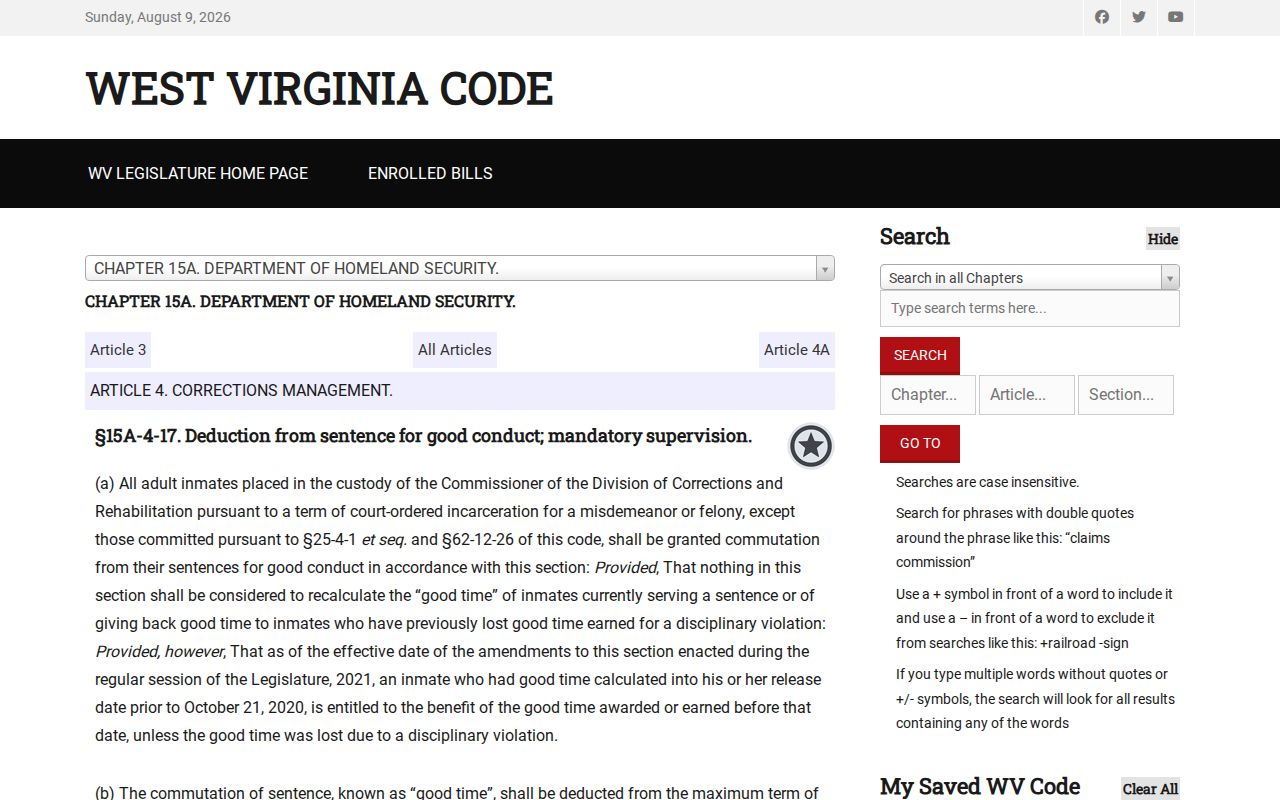
That source supports the day-for-day framework and its exceptions. It does not calculate an individual Fayette County release date without the sentence, credits, and official time sheet.
Policy 151.06 says the computer calculation uses applicable jail credit, good time, and street credit. Policy 151.07 requires a time sheet with the overall minimum discharge or final release date. When forfeiture, restoration, or added credit changes the result, the time sheet is revised.
Consecutive or cumulative sentences remain listed individually but are treated as one aggregate sentence for the calculation. That makes a single count's end date a poor substitute for the overall time-sheet result. It also explains why two people with similar sentence wording may have different projected dates after jail credit and other lawful adjustments are entered.
Fayette Minimum Discharge Rules
West Virginia's minimum discharge language creates an important Fayette County distinction. Certain specified felonies committed in the statute's covered period convert one year of accumulated good time into one year of mandatory post-release supervision. Other felony cases may involve a court-ordered period of mandatory supervision. In both settings, leaving the prison walls can begin supervised status before the sentence finally discharges.
Policy 454.10 also describes conditional post-release supervision before the minimum discharge date for some qualifying cases when discretionary parole has not occurred. An approved release plan is required. Detainers, another jurisdiction's custody, and certain alternative terms can affect eligibility. The sentence date and offense category therefore matter.
For Fayette County, the controlling concepts are eligible good time, minimum discharge, and final release. Treating physical departure as sentence completion would erase the mandatory-supervision layer.
The release plan is another practical dividing line. A calculated date may exist while placement, supervision, or another prerequisite remains unresolved. When a record uses conditional release language, confirm both the planned physical exit and the later final discharge. Those dates belong in separate fields and should never be collapsed into one claim.
Fayette Parole Eligibility Dates
Parole eligibility follows a separate body of law. Under §62-12-13, the baseline is generally the minimum of an indeterminate term or one fourth of a definite term, subject to exclusions and offense-date rules. Section 62-12-13a makes clear that reaching the minimum creates eligibility for consideration, not a right to release.
A Parole Board hearing can end in grant, contingent grant, denial, or deferral. A grant may still depend on an approved plan. For that reason, PED on a record should be read as a parole eligibility date, not converted to a projected gate date. The Board decision and later WVDCR custody event answer different questions.
Current amendments include date-specific rules for some life sentences tied to offenses on or after July 1, 2026. Read the version that applies to the offense and sentence date. An official time sheet and Decision Summary are safer than applying a general formula to a complex case.
Why Fayette Release Dates Change
A projected result is a snapshot of several inputs. Court action, WVDCR credit entries, conduct, and later custody claims can move the date or change what happens on that day. A screenshot proves what the system displayed then. It does not guarantee the future event.
| Change | Effect on the date or event | Best confirming record |
|---|---|---|
| Jail-credit correction | Adds or corrects qualifying time already served | Sentence order and revised WVDCR time sheet |
| Consecutive sentences | Aggregates terms for the overall calculation | Commitment orders and time sheet |
| Good-time forfeiture or restoration | Moves the calculated minimum discharge date | Revised WVDCR calculation |
| Program credit | May add limited statutory credit | WVDCR record and time sheet |
| New sentence or detainer | Can prevent community departure or shift custody | Facility release type and issuing-agency record |
| Parole action | May authorize supervised release, deny it, or defer a decision | Decision Summary and release record |
| Release-plan approval | Can control whether a conditional or contingent release proceeds | WVDCR or Board decision record |
A hold from another authority is especially important. A person can leave one WVDCR location yet remain in custody. The record should state transfer when another agency takes control, and a reader should avoid describing that movement as return to the community.
Court corrections can work in either direction. Added jail credit may move the calculation earlier, while a new consecutive sentence may move it later. Discipline and restored credit change the corrections input without changing the original conviction. For a reliable history, preserve both the earlier displayed result and the later revised time sheet, with the date each was issued.
Parole adds a decision rather than a simple subtraction. Eligibility may lead to denial or deferral, and a contingent grant may wait on a plan. Even a favorable Board action needs the later WVDCR event to show that physical release occurred. The projected date, Board decision, and gate event should be recorded as three distinct facts.
Confirm a Fayette Release Event
For a Southern Regional Jail sentence, contact the facility or WVDCR records function and identify the episode. Ask for the admission date, release date and time, releasing facility, recorded release type or authority, and transfer destination when releasable. A Fayette court order explains the sentence but may not state the exact checkout time.
For a Mount Olive or other prison sentence, request the effective time sheet and commitment/release information. Compare those records with the precise public-search label. Preserve the date on which the search was checked because public access and status can change.
Frame a WVDCR request around one person and one custody episode. Include the facility, approximate commitment dates, OID when known, and the Fayette case number. Ask for releasable commitment and release information, the effective time sheet, and the recorded release type. Inviting redaction is more useful than asking for the entire correctional file, which can contain protected personal and security material.
If the agency says another office holds the record, ask it to identify the custodian. Keep the acknowledgment, any fee notice, the pages produced, and a written denial. Those documents show which version of the calculation was in force and whether the requested date was withheld, unavailable, or maintained elsewhere.
The VINELink inmate search can provide a custody event or alert. VINE is a signal, not a guaranteed historical archive. If it conflicts with the court or WVDCR result, call the facility and obtain the release record before stating that someone left custody.
- Projected minimum discharge
- A calculated date that assumes continued incarceration and no later credit loss.
- Parole eligibility
- The point when consideration may occur, not an order of release.
- Conditional release
- Physical release subject to supervision and an approved plan.
- Final discharge
- The sentence endpoint shown by the governing corrections record.